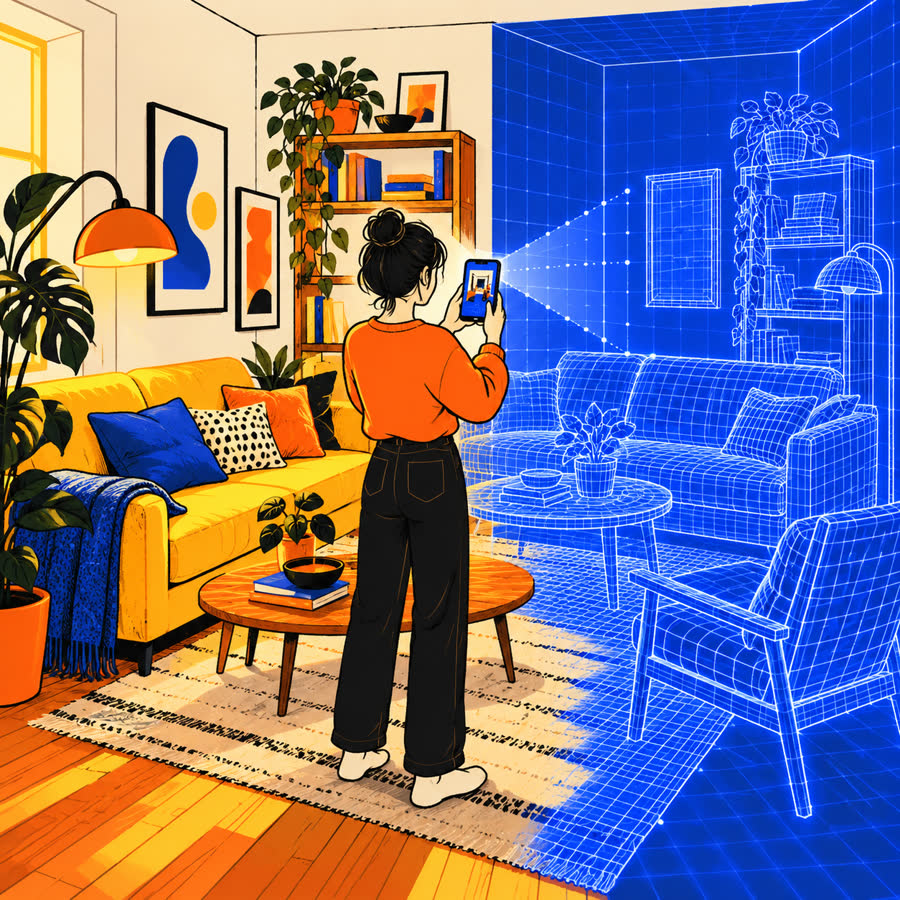
What this is
Exploring ways to reconstruct complete rooms and physical environments in 3D for use in WebGL, Three.js and virtual reality — a continuation of the older Virtual Spaces / MySpaces idea, now with photogrammetry, Gaussian splatting, NeRFs and AI-assisted reconstruction making it a genuinely different opportunity than it was a few years ago.
What's being tried
- Capturing a room with consumer hardware, not a scanning rig.
- Producing a navigable 3D representation from that capture.
- Combining geometric reconstruction with neural rendering.
- Bringing the result into Three.js or a VR experience.
The trade-off worth tracking: accuracy versus atmosphere, editable geometry versus visual fidelity, and efficient web delivery versus richness of detail. A clean geometric model can record dimensions while losing atmosphere; a neural rendering can preserve visual feeling while staying hard to edit as ordinary geometry.
Next
Getting one full room from capture to browser, end to end, before optimising any single step.
Earlier exploration
The starting point for this was Virtual Spaces, an earlier project using an Insta360 One X2 and Matterport to turn 360° photo sets into explorable 3D spaces — a home decorated for Christmas, a parish church during lockdown. Those captures are no longer live, but the idea carries forward directly into this work.
Current developments in neural rendering and Gaussian splatting are what make this a genuinely different opportunity now, rather than a rebuild of the same idea.